Restoring mangroves, opening the door to coastal resilience in Côte d'Ivoire and Ghana
For thousands of coastal families in Côte d’Ivoire and Ghana, a safe home depends not only on strong walls and roofs, but also on healthy ecosystems. Mangroves serve as a natural barrier against flooding, erosion and storm surges, helping protect homes, livelihoods and communities from the growing impacts of climate change.
Mangroves are not just trees — they are a specialized coastal wetland ecosystem found in tropical and subtropical zones, and one of nature’s most effective tools for adaptation. Below the surface, their roots hold dense stores of carbon, helping combat climate change. And by providing breeding grounds for fish, they sustain the local fisheries many coastal families depend on for income and food.
Despite this, mangroves remain one of the world’s most threatened tropical wetland ecosystems; and across West Africa, that threat has been building for decades.
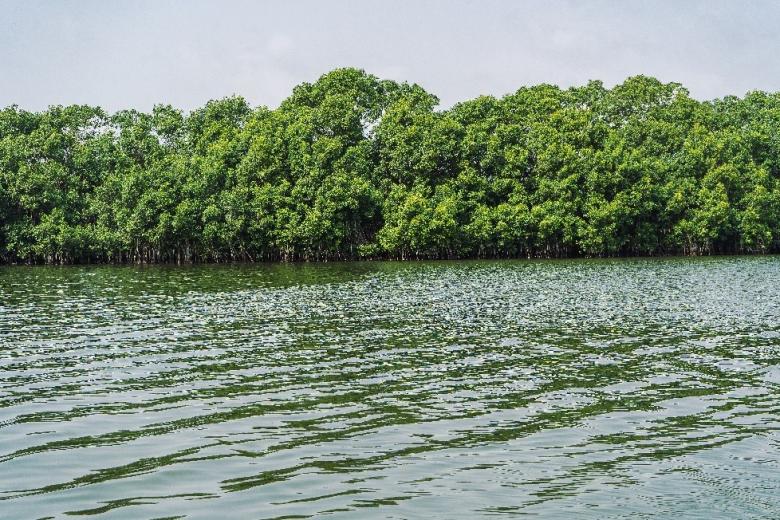
Mangrove plantation in Azuretti, Cote d’Ivoire
Côte d’Ivoire is estimated to have lost more than 90% of its mangroves between the 1970s and 2013. In Ghana, more than 60% of the coastline is now vulnerable to erosion and flooding, and the country’s remaining 13,000–14,000 hectares of mangrove forest — concentrated in the Volta Delta, Keta Lagoon Complex, Songor Lagoon, Densu Delta, Muni Lagoon, and Ankobra Estuary, according to the Forestry Commission of Ghana, Global Mangrove Watch, the IUCN Red List of Ecosystems Programme, and the Ramsar Information Service — continue to shrink under pressure from unsustainable harvesting, urban expansion, salt mining, pollution, and climate change.
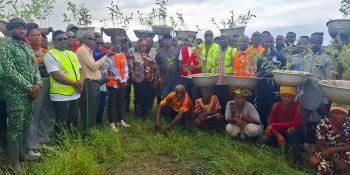
To mark the 2026 World Mangrove Day, Habitat for Humanity joined partners including UN-Habitat Côte d’Ivoire and ActionAid Ghana alongside communities to launch large-scale mangrove restoration activities under the Improved Resilience of Coastal Communities (IRCC) Project, supported by the Adaptation Fund.
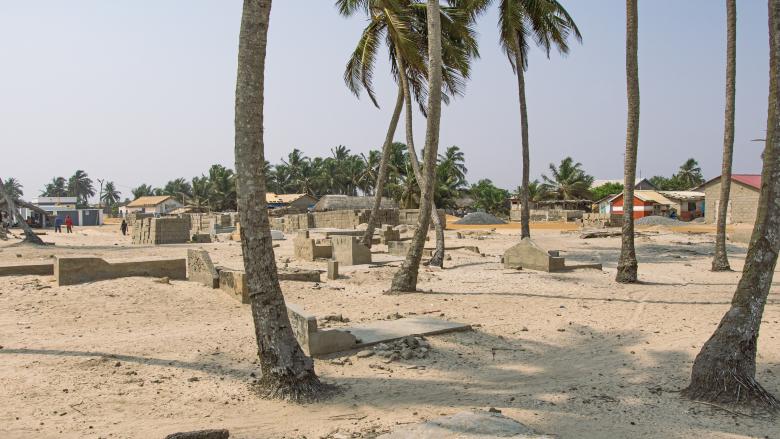
Coastal erosion in Ada West, Cote d’Ivoire as a result of mangrove degradation
Ghana: from Anloga to Ada West
In Ghana, restoration efforts are already underway. More than 95,000 mangrove seedlings have been planted in Anloga District, with an additional 95,000 seedlings set to be planted across 38 hectares in Ada West. Ultimately, the project aims to restore 479 hectares of degraded mangrove ecosystems across the Greater Accra and Volta regions.
The Volta Delta, where much of this work is concentrated, is recognized as one of West Africa’s most important coastal wetland ecosystems, supporting thousands of people through fishing, farming, and salt production.
As Malik Gbene, ActionAid Ghana’s Quality and Knowledge Manager, put it:
“Climate justice begins with community-led action. It is our collective responsibility to restore what is lost by planting new seedlings. By investing in mangrove restoration today, we are protecting livelihoods, strengthening coastal resilience, and safeguarding the environment for future generations.”


Côte d’Ivoire: from Jacqueville to Grand-Bassam
In Côte d’Ivoire, just days ahead of World Mangrove Day, partners marked the start of the mangrove restoration efforts with a ceremony in the village of Attoutou B, Jacqueville. The exercise targets restoration of 58 hectares across five communities in Jacqueville followed by 45 hectares in Grand-Bassam.
“When we restore mangroves, we are not simply planting trees—we are rebuilding the future of coastal communities.” Alioune Ndiaye, Chief of Party, Habitat for Humanity.
Across both countries, the project aims to restore mangroves at scale, with nearly 87,000 people expected to directly benefit over the long term from the ecosystem services and protection these restored coastal forests provide.


Communities leading the way
Local communities are at the heart of the restoration process, s from collecting propagules and managing nurseries, to planting and monitoring seedlings. Their leadership ensures restoration efforts are locally owned, sustainable and responsive to community needs.
Opening the door to climate resilience
This work reflects the vision of Habitat for Humanity’s Let’s Open the Door campaign, which calls for collective action to expand access to safe, resilient housing and stronger communities. By restoring mangroves, we are opening the door to greater climate resilience, helping coastal families protect their homes, secure their livelihoods, and build a more sustainable future.


The Improved Resilience of Coastal Communities project, financed by the Adaptation Fund, works with 21 coastal communities across Côte d’Ivoire and Ghana to strengthen resilience through nature-based solutions, improved infrastructure, and ecosystem restoration, creating lasting benefits for people and the places they call home.
UN-Habitat serves as the project’s Implementing Entity, with the nature-based solutions component led by Habitat for Humanity International and implemented in Ghana together with ActionAid Ghana.
Learn more about the project: Adaptation Fund Project - Habitat for Humanity Côte d’Ivoire